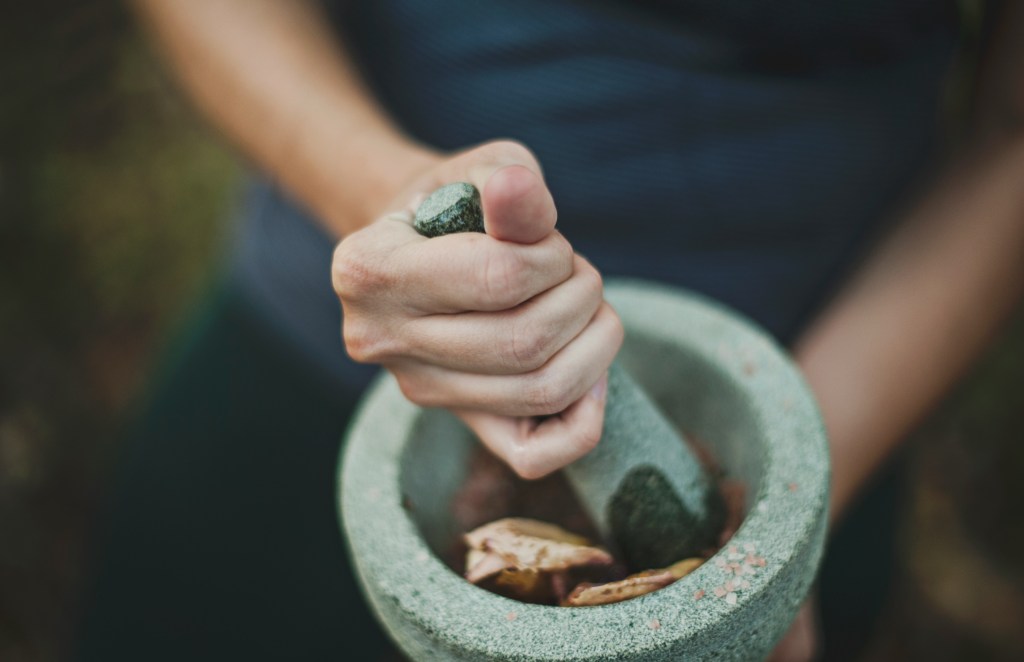
I reached for the dried sprig of sage that was placed upright in a small glass container and removed a few leaves. As I dropped them into a small mortal, I felt my favorite trifecta of grounding – the mindful-ritual-rooted vibration – surrounded me, feeling like balm for my soul. The pestle scraped against the granite bowl in a soothing circular motion as wisps of the herb filled the air with a heavy cozy scent. I was thinking about sage and its effect on sore throats and snotty noses (midwest mom of three here). I was visualizing its healing properties nourishing my family, a ritual I learned from my Mother (who’s favorite love language is undoubtedly cooking). And reflected on how deeply the yearning to learn more about plants, their medicine, and their spirit has switched on in me. Realizing that there could be a much more soulful connection to what I cook or ingest beyond a list of flavors or ingredients. That bringing my awareness to this connection could transform herbs from items I buy at my local grocer to extraordinary gifts bestowed from Mother Earth.
The Gaia theory postulates that the Earth is its own conscious living organism, one who provides a purposefully optimal environment for its biological inhabitants. I wondered if my ancestors knew this to be true, just like how they knew the sun would rise in the morning. That the land, sky, and water had a form of consciousness that communicated in subtle ways if we knew how to listen. Perhaps that is why they celebrated the change of the seasons together, marking cycles with gratitude to their planet. The land was not a place to pillage and poison, but rather a generous spirit to receive from and give back to.
But, pillaging, poisoning, and profiting slowly spread and became normalized. And although we are indeed part of this beautiful intricate organism, over time we have been systematically severed from her, and her many gifts. The campaign to rid the practice of herbalism in the US around the early 1900s is just one example. As 100s of thousands of Americans bought herbal remedies and formulas for their home apothecaries, there was a concerted effort to “standardize” and control the “practice of medicine.” The American Medical Association, Rockefeller, and Carnegie commissioned a survey that criticized Eclectic medical schools – places that taught competent physicians botanical medicine, physiology, and herbal and energetic traditions.
“These efforts by the medical establishment, paired with people like the Rockefellers and the Carnegies, were successful in turning the majority of people away from herbalism, painting a picture for the masses that herbalism was a relic of the past, was outmoded quaint superstition. The Eclectics, who were always most popular in rural America, were increasingly seen this way. They were unscientific, clinging to plant medicines rather than the new miracle drugs created in laboratories (aspirin, sulfa drugs). And anyway, Allopathic (regular) physicians, no longer heroically bled patients or gave large doses of toxic medicines, so less dangerous alternatives were no longer necessary. Improved hygiene had also reduced the dangers of many terrible diseases that were once common. The last Eclectic Medical school closed in Cincinnati in 1939, but really by the 1920s you could no longer find herbal preparations in any shop in America. “
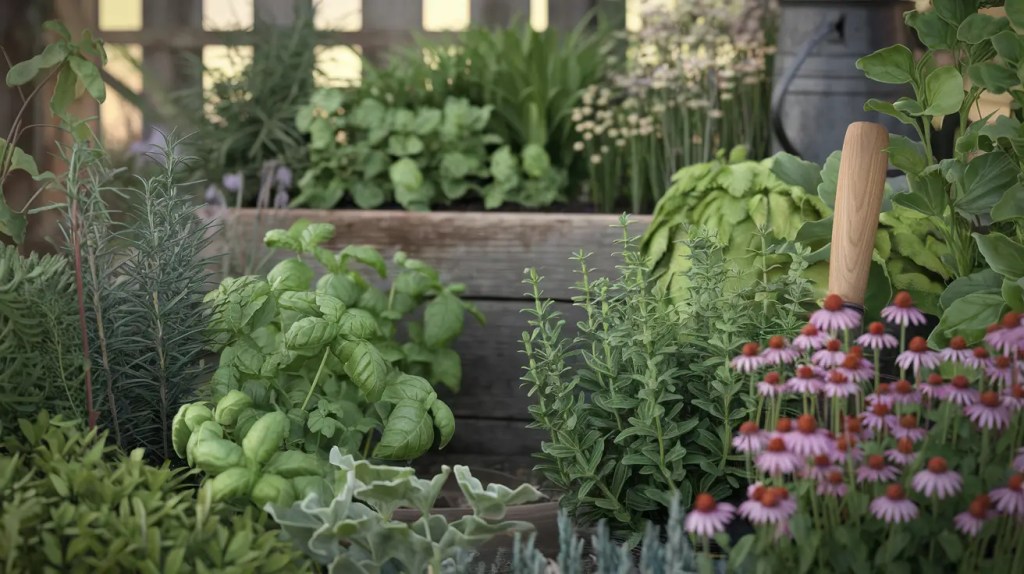
Interested in digging a bit deeper, I looked up how early herbalism was practiced by my ancestors of European descent. There seemed to be many translations of the originally Greek De Materia Medica, one of the oldest known manuscripts (60 CE) that contains approximately 600 plants for more than 1,000 traditional medicines. I found early works of herbalism by Hildegard of Bingen (1098-1179) who wrote several books on the natural world’s healing properties, medicinal virtues of plants, and weaved in her “theological perspective that stressed balance and harmony in the body”. But as time went on, and the sovereignty to heal was claimed by the Christian dominance of the medieval times, herbal practitioners (and their wealth of knowledge) were slowly eliminated.
But all these years later, it feels as though we are awakening. We are remembering. Our DNA holds the memory of what our ancestors knew. That we aren’t separate from Earth. That we ARE Earth.
Digging even deeper (inspired after reading about these witchy herbal healers) I was curious about herbal grimoires and their history. They seemed similar to a materia medica but with a bit more spirit – denoting not just the plant and its properties but also the energetics and spirit of the plant. How to
“not view these entities as mere ingredients. They are our partners. They are living beings with awareness, reactions, and powers that they teach us and share with us. When a witch enters into a magickal partnership with herbs, healing and transformation take place”
The Modern Witchcraft Guide to Magickal Herbs by Judy Ann Nock
And suddenly, with living plant beings having powers that can teach us and share with us, my old porcelain soup pot morphed into a modern day cauldron. Perhaps my spell is simply wishing health and happiness to my family with every stir. My altar is a stovetop as I stand before it, thanking the sage and rosemary and beautiful butternut squash for its gifts. My magic is noticing the subtle shift within myself when I drop my attention down into my body and somatically experience the beautiful simple act of cooking a meal. The mind-spiritbody-earth vibration felt more vibrant than before. The gateway to this connection was herbalism. It felt like a blend of ethereal and Earthy. It was Earthereal. And just like that, I was enchanted.
“These powerful plants also connect us to each other and to the past. It is comforting to know that the cycle of seed to leaf and flower to fruit will still hold sway and inform {folx} years from now, just as those who came before. As you discover and grow in this sacred path, know that the power of herbs has been here all along, ready to enchant, seduce, empower, inspire, and enlighten. Revel in the wisdom of ancient folk medicine that is still in use today”
Judy Ann Nock
If studying herbalism (and growing your own herbs) sounds like something that stirs curiosity in your heart and soul as well, we would LOVE to have you join us for a 2.5 hour workshop – The Healing Garden on our Spring Equinox March 21st 11a – 130p
– Carolyn
 Dayton Wellness Collective
Leave a comment